
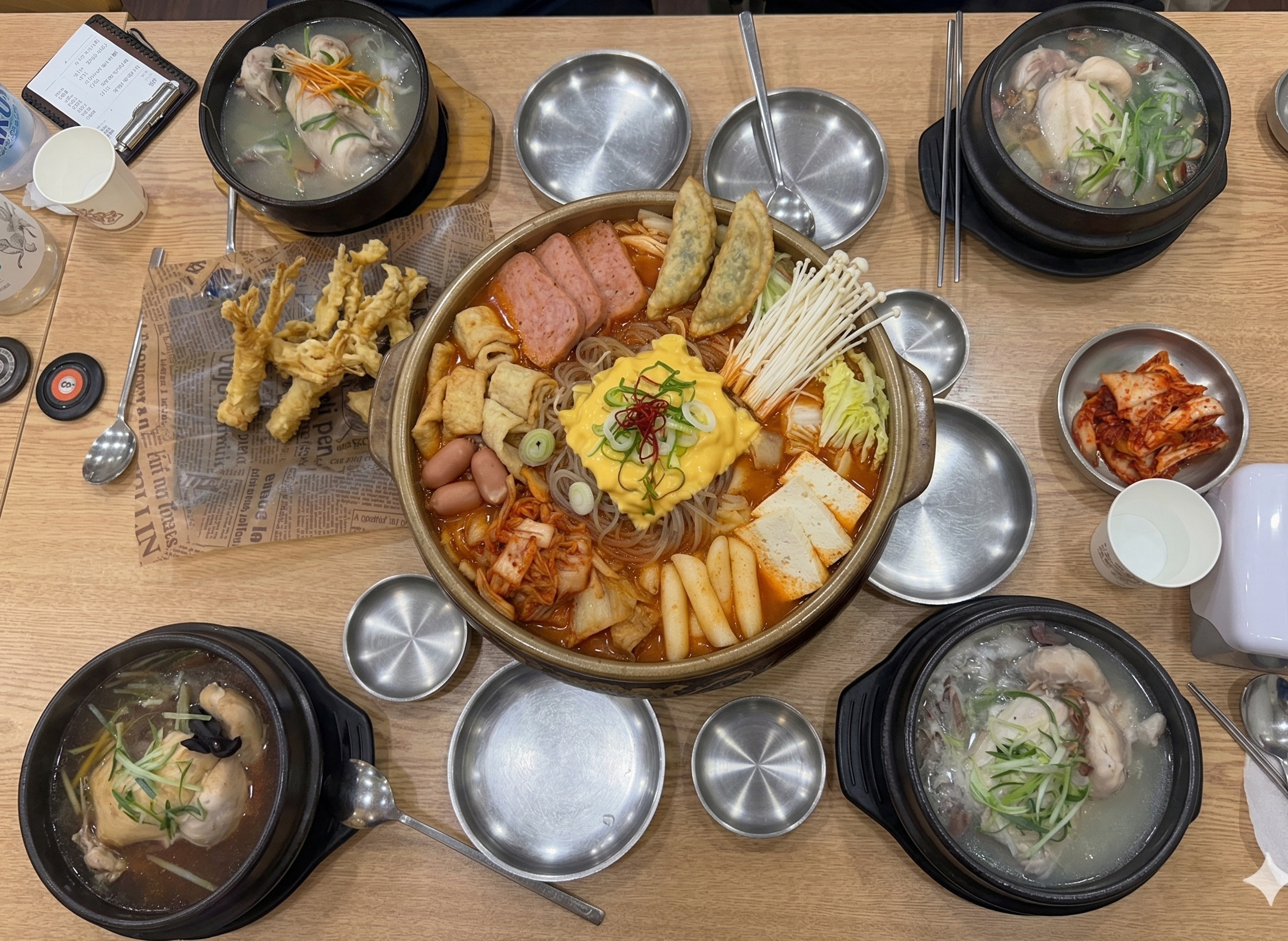
About twenty years ago, I was sitting at the dinner table with some Korean colleagues. We didn’t understand each other’s languages very well: they didn’t know English, and I only knew a few words of Korean. But we smiled, exchanged gestures, and ate from the common plate. I noticed how the tension of those first few minutes gradually melted away. The conversation flowed slowly, but the warmth between us grew faster. When we said goodbye, one of them quietly said, “We have a word for this.” He wrote two characters on a napkin: 心情 — simjeong.
Simjeong (심정) is a Korean word with no exact translation. The character 心 means “heart,” and 情 means “feeling” or “connection.” Together, they describe not just an emotion, but an inner impulse of the heart—a longing for love, joy, and genuine connection with another person. It is not a state of solitary experience: simjeong develops only within relationships. When the hearts of two people “hear” one another and are on the same wavelength—that is it. Korean culture places simjeong at the center of how people build connections, communicate, and find meaning in life.
Roots that run deep
This concept has a history spanning millennia. In the 15th century, when King Sejong the Great created the Korean alphabet—Hangul—the accompanying document “Hunminjeongeum Hyeorye” emphasized: language expresses the human heart. Even earlier, in 1145, the chronicles of the “Samguk Sagi” recorded the moral values of the ancient Koreans through the lens of the heart and the bonds between people.
Confucian thought, which took root in Korea, enriched simjeong with yet another dimension. Alongside it, the concept of jeong (정)—a deep bond that forms between people over time—developed. Not love at first sight, but something that grows slowly—through shared meals, daily care, and hardships endured together. During the Joseon era, philosophers Yi Hwan and Yi I placed the heart at the center of ethics. They noted that it is not reason, nor law, but the heart that determines how a person lives among others.
Today, simjeong lives on in Korean dramas and poetry, in the wedding ritual of sharing a single cup, and in the Chuseok festival, where families gather to honor both the living and those who have passed away. It is not a museum artifact—it is a cultural code that still pulses with life.
The heart speaks many languages
But is simjeong a uniquely Korean phenomenon? If we look more broadly—no.
The ancient Greeks had four different words for love: eros—passionate love, philia—friendship, storge—family affection, and agape—unconditional love for all. Each word is precise and distinct. Simjeong is as if all four combined: like the living movement of the heart, rather than a taxonomy of feelings.
In Indian philosophy, “prema” (prema) describes a sacred, boundless love that transcends the body and the self. Different cultural guises—but the same vector: from the human to the universal.
In African and Indigenous American cultures, love is inseparable from community, nature, and ancestors. Joy is collective; connection runs deeper than the individual. This resonates with the Korean sense of “we-oneness,” where a person realizes themselves not outside of relationships, but precisely through them.
And in Ukraine? Hryhorii Skovoroda, an 18th-century wandering philosopher, built an entire system of thought centered on the heart. His heart-centered philosophy proclaimed: true human happiness lies not in external achievements, but in knowing oneself through the heart and living in harmony with it. In his treatise “The Conversation of Five Travelers on True Happiness,” Skovoroda wrote that external pursuits lead a person away from themselves. “Know thyself” meant for him, above all, to listen to one’s own heart.
Skovoroda and Korean thinkers did not read each other’s works. They lived in different cultures, in different eras. But they reached a similar conclusion: the heart is not a metaphor, but the center of human existence.
Why do we need this now
In an age when we send hundreds of messages a day but often feel lonely, simjeong reminds us that true connection between people is not an exchange of information, but a resonance of hearts. Psychology confirms this. Abraham Maslow placed the need for love and belonging at the center of his hierarchy of needs—above physiological survival. John Bowlby’s attachment theory shows that the capacity for deep emotional connection is formed in early childhood and determines our well-being throughout our lives. Martin Seligman, in positive psychology, proved that deep relationships are one of the key components of happiness.
Shimjeong simply gives a name to all of this. Beautiful, quiet, precise.
That napkin didn’t survive; it got lost somewhere. But when I recall that meeting, those people, or look at the two characters for 心情 (shimjeong), I feel the warmth of that day in my heart once again. Now I understand that that evening at the table with my Korean colleagues had a name long before I learned it. Shimjeong doesn’t need a translation—only attention to what happens between people when they are truly close.